
Keep your grooming schedule on time
Set realistic durations, protect travel time, and handle delays before they affect the whole day.
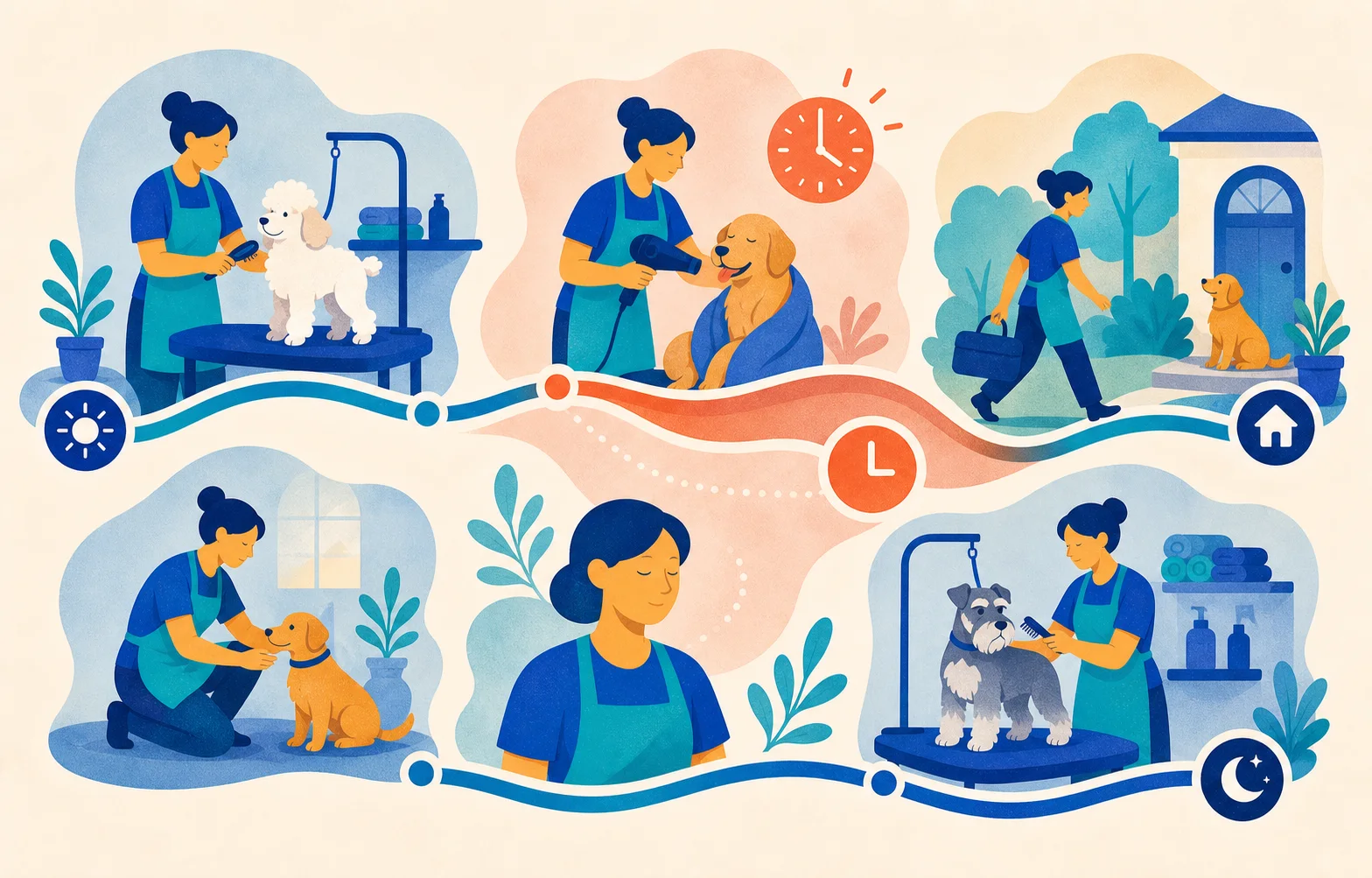
A late day usually starts before the first pet arrives
Most grooming days do not become late because one appointment went wrong. They become late because the schedule was already too tight. A small delay in the first appointment becomes a bigger delay by lunch, and by the end of the day the team is rushing, customers are waiting, and the pets feel the pressure too.
For small grooming businesses, the goal is not to squeeze every empty space in the calendar. The goal is to protect the rhythm of the day. A calmer day usually leads to better grooming work, better customer communication, and fewer mistakes.
Start with realistic service durations
Every service should have a base duration, but that duration should be treated as a guide, not a promise. A small dog full groom may take one hour on paper, but an anxious dog, a matted coat, or a senior pet can change the day quickly.
One useful habit is to keep standard durations in the price list, then adjust the duration at the appointment level when the pet is known to need more time. If the same pet always takes longer, record that against the pet so the next appointment starts from a realistic estimate instead of the standard estimate.
Protect transition time
Back-to-back grooming is only safe when the next pet is already at the same place and the team does not need to reset much. House-call grooming is different. Travel, parking, unpacking, setup, and customer conversation all take time.
If the schedule mixes in-house grooming and house-call grooming, the route matters. In-house to in-house can usually be back-to-back. House-call to house-call needs travel time. In-house to house-call also needs travel time because the team must move out. House-call to in-house needs travel time because the team must return.
Use small buffers where they matter most
A good buffer does not have to be large. Even 15 to 30 minutes between risky appointments can protect the entire day. The best places for buffers are after full grooms, after known anxious pets, before the last appointment of the day, and around appointments that require travel.
A buffer is not wasted time. It is the time that keeps the business professional when real life happens.
Review the day before confirming everything
Before the schedule is treated as final, look at the day as a sequence. Check who is doing each appointment, whether the services fit the time allowed, whether house-call travel is possible, and whether any pet notes require special handling.
The best grooming schedules do not only answer "is there a slot?" They answer "can the team actually do this well?"